
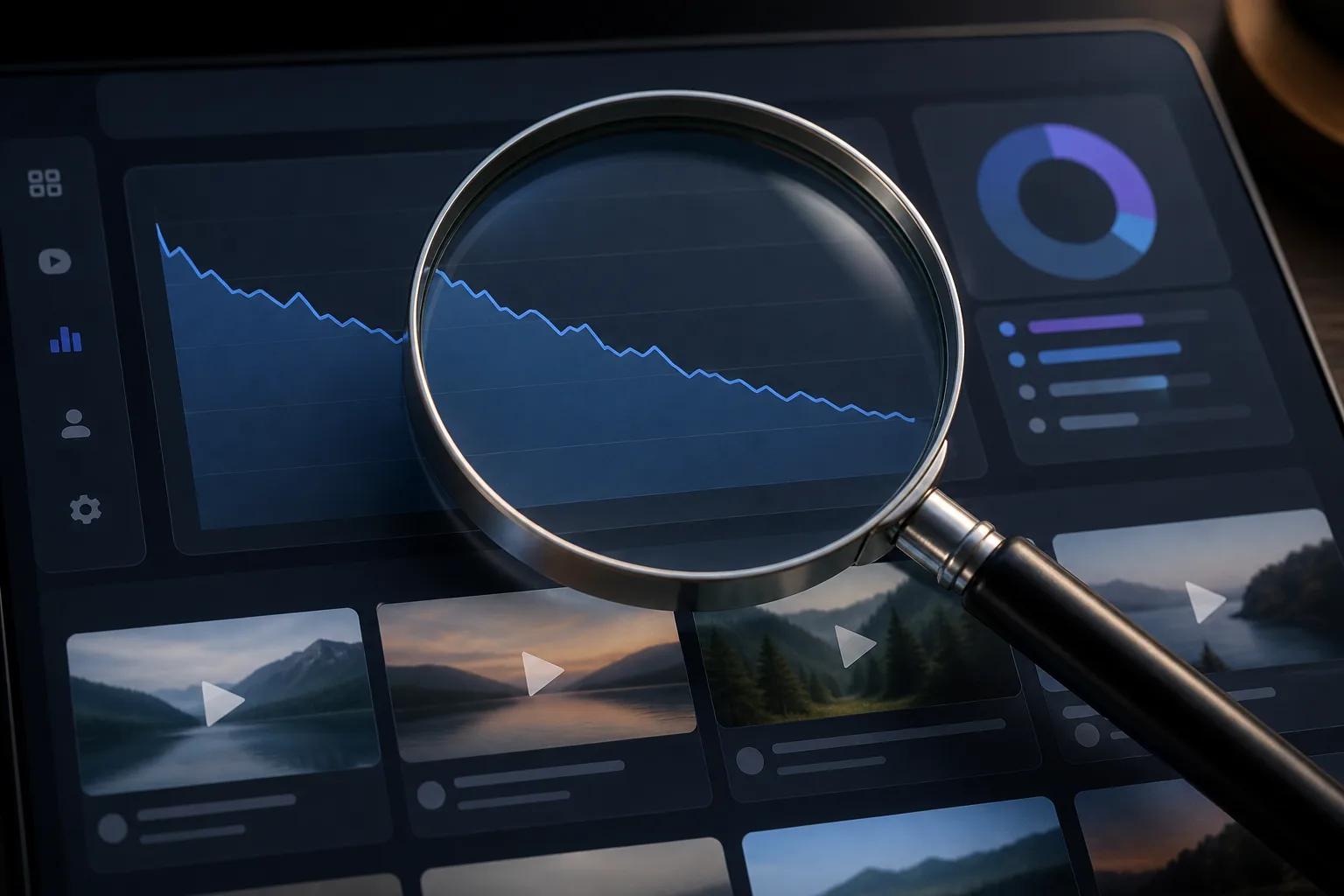
Short answer: To grow a small YouTube channel when views have stalled, compare monthly performance across multiple videos, diagnose impressions, CTR, and retention together, then test focused changes and monitor the results over a few weeks. How to Grow a Small YouTube Channel When Views Have Stalled starts with distinguishing a broader pattern from normal week-to-week noise.
- A YouTube impression is counted each time a video thumbnail is shown to a viewer on YouTube.
- Impressions CTR is the percentage of impressions that result in someone clicking the video.
- The Content tab shows impressions and CTR averaged across content and identifies top-performing videos.
- A CTR increase paired with falling views across three or more videos in a row can signal an issue beyond one video’s lifecycle.
- For a posting-time test, the source recommends testing for two weeks and comparing average views and engagement.
How to Grow a Small YouTube Channel When Views Have Stalled: how do you confirm the slowdown?
To confirm whether your YouTube channel’s views have stalled, compare monthly performance and look for a pattern across multiple videos rather than reacting to week-to-week movement. A traffic dip can reflect seasonality or algorithm testing, and weekly data may be noise while monthly data gives a clearer signal.
How to Grow a Small YouTube Channel When Views Have Stalled starts with separating a single video’s lifecycle from a channel-wide pattern. A CTR increase paired with falling views on one video can be normal late in that video’s lifecycle; the same pattern across three or more videos in a row may signal a broader issue.
Also, a video’s CTR can fall as it reaches new audiences even when views and watch time are performing well. So, when asking How to Grow a Small YouTube Channel When Views Have Stalled, compare a cluster of videos over time; don’t let one CTR change decide the diagnosis. That’s the practical check behind How to Grow a Small YouTube Channel When Views Have Stalled.
Check YouTube growth service reviews
Which YouTube Analytics metrics can show why views are declining?
Use impressions to see how often YouTube showed your thumbnail, CTR to see what share of those impressions became clicks, and watch time or retention to check whether viewers stayed. How to Grow a Small YouTube Channel When Views Have Stalled means reading those signals together, not treating one metric as proof of the cause.
The Content tab shows impressions and CTR averaged across content, while the Reach tab includes impressions, CTR, unique viewers, and traffic sources. To inspect retention, open the affected video’s Analytics, select Engagement, then Audience retention.
The diagnostic table below separates reach, click, and retention patterns. High impressions with low CTR can point to a title or thumbnail issue; high impressions and CTR paired with low watch time can indicate that the video isn’t holding attention. Low impressions, weak retention, and few returning viewers are associated with a disconnected channel. How to Grow a Small YouTube Channel When Views Have Stalled also requires context: there’s no single CTR threshold for a healthy channel. Keep that in mind as you use How to Grow a Small YouTube Channel When Views Have Stalled to interpret the numbers.

When should you change a video’s title or thumbnail?
Consider changing a title or thumbnail when a video’s CTR is low relative to your channel’s average and niche, especially if impressions are high but viewers aren’t clicking. How to Grow a Small YouTube Channel When Views Have Stalled calls for a comparison with your own audience and topic, not an automatic response to a single percentage.
The sources give different reference points: one describes 5% or higher as a solid goal, while another places average CTR around 4–5% and says 2–10% can be within the normal range. Since there’s no single healthy-channel threshold, those figures shouldn’t be treated as a universal pass/fail rule.
If CTR is low, improving the title and thumbnail may be worthwhile, but avoid clickbait. If retention has dropped meaningfully, prioritize fixing the first seconds before changing the thumbnail. For How to Grow a Small YouTube Channel When Views Have Stalled, diagnose whether the issue is getting the click or holding attention before choosing the change. That distinction matters when applying How to Grow a Small YouTube Channel When Views Have Stalled to an individual upload.

Hand YouTube growth service to a pro
How can you find topics that interest current viewers and attract new ones?
Use YouTube Analytics to identify what your viewers already watch and what they search for but struggle to find, then shape those clues around a clear channel promise. The Audience tab shows other content viewers watch and channels they follow, while the Research feature can surface searches that are hard to satisfy.
How to Grow a Small YouTube Channel When Views Have Stalled also means checking your own back catalogue: list the top five videos each month and note what they have in common. View spikes along a video timeline can help identify which moments resonated with viewers.
Make one clear promise for the channel, audit the last five uploads against it, and plan the next three videos around topics that reinforce it. Keep each video’s title, thumbnail, and core idea pointing in the same direction. That gives How to Grow a Small YouTube Channel When Views Have Stalled a concrete editorial check: does each proposed topic fit the channel’s promise? Use that check consistently as part of How to Grow a Small YouTube Channel When Views Have Stalled.

How often should a small channel publish while testing new ideas?
The available guidance doesn’t establish a specific weekly or monthly publishing frequency for a small channel. It advises against responding to stalled views simply by uploading more and instead recommends stepping back to clarify the channel’s direction.
How to Grow a Small YouTube Channel When Views Have Stalled is therefore less about filling a calendar and more about deciding what each upload is meant to test or serve. You can define the topic, format, or video length you want to learn about, but the claims here don’t provide a schedule for publishing those experiments.
Keep the channel promise in view while planning; don’t treat extra uploads as a proven fix for declining views. How to Grow a Small YouTube Channel When Views Have Stalled calls for a clear direction, not an invented cadence. Since no frequency is specified, choose a schedule only when it fits your own capacity and testing plan; How to Grow a Small YouTube Channel When Views Have Stalled does not come with a source-backed weekly quota.
Browse YouTube growth service services
What are the costs and trade-offs of using ads or paid promotion?
The available source reports average ad-campaign CTRs of about 0.84% and CPMs near $3.53; those are reported figures, not promised costs or results. How to Grow a Small YouTube Channel When Views Have Stalled can include paid promotion as one consideration, but those figures don’t establish what a particular campaign will deliver.
The same source says organic performance remains the biggest growth lever when optimized. That makes paid promotion a trade-off to weigh against improving the video and channel experience for viewers, rather than a guaranteed route to renewed growth.
The available claims don’t provide a full budget range or a guaranteed return from paid promotion. They also don’t establish a specific amount you should spend. For How to Grow a Small YouTube Channel When Views Have Stalled, treat the reported CTR and CPM as context, not a forecast. How to Grow a Small YouTube Channel When Views Have Stalled should still include attention to organic performance, the source’s stated largest growth lever.
How can you test titles, thumbnails, and video formats without muddling the results?
Keep each video’s title, thumbnail, and core idea aligned, then compare experiments using consistent measures such as CTR, watch time, and retention. How to Grow a Small YouTube Channel When Views Have Stalled is easier to evaluate when each test has a clear question and the same metrics are checked across attempts.
One suggested format test compares five-minute and ten-minute videos on identical topics. That gives you an example of changing video length while keeping the topic consistent. The source describes four to six tests as a way to build a blueprint based on audience data.
Avoid treating one upload as a final verdict. Broadening a channel’s packaging toward a wider audience is described as a several-week project, not a single-upload adjustment. For How to Grow a Small YouTube Channel When Views Have Stalled, keep the comparison focused and record the same signals each time. The purpose of How to Grow a Small YouTube Channel When Views Have Stalled testing is to learn from comparable results, not to change every element at once.
How long should you wait after changes, and what shows that views are recovering?
Wait at least two full days before analyzing a new upload, then monitor metrics over a few weeks and compare performance between videos. How to Grow a Small YouTube Channel When Views Have Stalled requires a longer view than an immediate post-upload reaction, while still allowing you to check changes consistently.
For a posting-time experiment, test for two weeks and compare average views and engagement. Track impressions, CTR, watch time, retention, and returning viewers as relevant signals; the Reach tab includes impressions and CTR, and the retention graph shows where viewers stay or leave. Low impressions, weak retention, and few returning viewers are associated with a disconnected channel, but no one signal alone proves recovery.
If one video’s CTR rises while views fall, the source suggests publishing the next upload and checking again. How to Grow a Small YouTube Channel When Views Have Stalled means looking for improvement across relevant signals and more than one upload. Use that measured follow-up—not a single result—as the basis for How to Grow a Small YouTube Channel When Views Have Stalled.
Compare YouTube growth service experts
| Source | CTR statement |
|---|---|
| subscribr.ai | Aiming for a CTR of 5% or higher as a solid goal. |
| tastyedits.com | Average YouTube CTR around 4–5%, with 2–10% still within the normal range. |
| sociality.io | Average ad-campaign CTRs of about 0.84%. |
| Pattern to inspect | What the pattern may indicate |
|---|---|
| Reach | Low impressions, weak retention, and few returning viewers are associated with a disconnected channel. |
| Click | High impressions paired with low CTR can indicate that the title and thumbnail aren’t compelling viewers to click. |
| Retention | High impressions and CTR paired with low watch time or average view duration can indicate that the video isn’t holding viewers’ attention. |
What the data says
- Compare monthly channel performance and look for patterns across multiple videos before making strategic changes.
- Use impressions, CTR, watch time, and retention together to identify whether the weakness is reach, clicks, or viewer attention.
- Align each video’s title, thumbnail, and core idea, and compare experiments using consistent metrics.
- Wait at least two full days before analyzing a new upload and monitor performance over a few weeks.
Reader questions
How can you tell whether views have genuinely stalled?
Compare monthly results and look for patterns across multiple videos before treating a slowdown as real; weekly changes may reflect noise, seasonality, or algorithm testing.
Which analytics metrics help explain declining views?
Impressions, click-through rate, watch time, and audience retention can help identify where performance is weakening; no single CTR threshold defines a healthy channel.
When should you change a title or thumbnail?
Consider improving a title or thumbnail when CTR is low relative to your channel’s average and niche, but first address a meaningful retention drop by fixing the first seconds.
How can you find topics for current and new viewers?
Use the Audience tab and Research feature to find viewer interests and searches that are hard to satisfy, then plan videos around a clear channel promise.
How often should a small channel publish while testing ideas?
The available claims don’t establish a specific publishing frequency; they advise against simply uploading more and recommend clarifying the channel’s direction.
